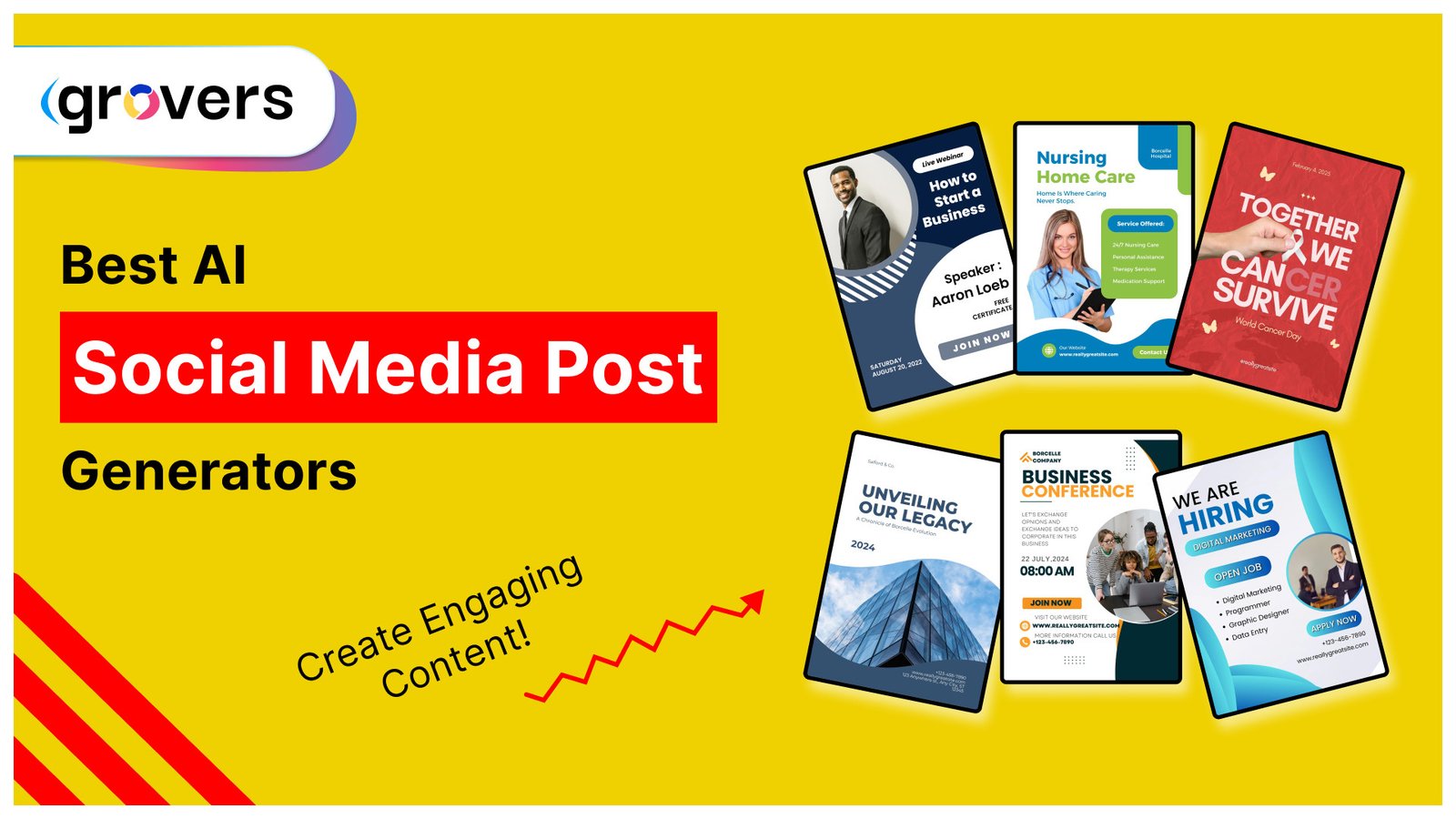
The problem of social media ideas does not worry most people. They are having a hard time converting such ideas into a good-looking, on-brand, and real-life post. You open your design tool, look at a blank screen, and 10 minutes later, you still have a feeling that you are not sure of what you have created. This is what makes a lot of creators and businesses seek AI social media post generators. It is not supposed to replace creativity, but to avoid the slow, repetitive aspect of the process.
How I approached choosing the right tools

When I began trying these AI tools, I did not walk in with a desire to find the flashiest features or the most features. I did it like any other person who can use it as a daily social media post maker. Would I be able to open it, write a post in a short time, and be confident enough to post it without it being heavily edited?
I tried the ease of the process between the idea and a completed post, the naturalness of the writing, and the amount of handcrafting of the design required. The flexibility of the layouts also attracted my attention since a tool would not be useful when all the posts begin to look alike. There were tools that were fast at drafting but poor at graphics. The others were also well-dressed but provided rather generic text. The tools that really impressed were the ones that were useful and even useful in creating actual content that can be used, rather than pretty demos.
What I actually looked for while testing these tools

I was not impressed by the list of features; I paid attention to the way in which every AI social media post maker works in practice. Not demos. Not marketing pages. Real workflows. Real posts. The type you are literally posting on a brand page or business account on a post maker on a social media platform.
Here’s what mattered most to me:
Post quality:
Is the look of the post natural and clean, or does it appear rushed and generic? An effective post must appear natural, but not artificial.
Speed and flow:
What is the speed at which you can move through ideas to a finished post? When a tool is more difficult to learn than it saves on time, it is not helping.
Design flexibility:
Are you easily able to manipulate layouts, fonts, spacing, and structure? High-quality tools allow changing the posts, rather than using the same form each time.
Text usefulness:
Is the AI-produced content usable, or must you rewrite everything? There are tools that are good visuals, but not copy.
Consistency:
Does it allow you to use it on a daily basis without it appearing just like all posts? This is of importance in case you are aiming to create an actual brand presence.
AI Social Media Post Generator Comparison
| Tool | Best For | Text Quality | Design Quality | Templates | Automation | Ease of Use | Free Option |
| Design.com | All-in-one branded content | Good | Strong | 1M+ | High | Very Easy | Yes |
| BrandCrowd | Fast, designer-made templates | Basic | Strong | Thousands | Low | Easy | Yes |
| Predis.ai | AI automation workflows | Good | Good | Yes | High | Easy | Limited |
| Canva AI | Visual-first creators | Good | Strong | Yes | Medium | Very Easy | Yes |
| Simplified AI | All-in-one content | Good | Good | Yes | Medium | Easy | Yes |
| Ocoya | Scheduled content + AI | Good | Medium | Yes | High | Medium | Trial |
| Lately.ai | Content repurposing | Strong | Medium | No | High | Medium | Trial |
| VistaCreate AI | Design-focused brands | Medium | Strong | Yes | Low | Easy | Yes |
| SocialBee | Content scheduling & automation | Strong | Basic | Limited | High | Medium | No |
The Best AI Social Media Post Generators
1. Design.com

Design.com is an all-in-one branding platform that makes creating social media posts fast and consistent across every channel. Once you build your logo and brand kit, the platform automatically carries your colors, fonts, and style into over one million social media templates – covering posts, stories, banners, and covers for Instagram, Facebook, LinkedIn, TikTok, YouTube, and more. There is no need to redefine your branding every time you create a new post; Design.com applies it all for you. It is the best pick when you want every social post to look on-brand without spending time on design from scratch. You can also explore the full feature breakdown here.
Pros:
- Auto-applies brand colors and fonts
- 1M+ templates across all platforms
- No design experience needed
- Free to start with no credit card
Cons:
- Full template access needs a paid plan
- Not a scheduling or publishing tool
Pricing:
Free to use. Paid plans from $5/month (billed annually).
2. BrandCrowd

BrandCrowd is a designer-curated social media post generator with thousands of professionally made templates covering every major platform – Instagram, Facebook, LinkedIn, YouTube, TikTok, Twitter, and even WhatsApp. Each template is pre-sized for its platform, so you never have to manually resize your designs. You simply enter your business name, pick a template, customize colors, fonts, and layout using the drag-and-drop editor, and download your finished post in high resolution. It is ideal when you want consistent, professional-looking social media graphics fast without hiring a designer. You can also explore the full feature breakdown here.
Pros:
- Pre-sized for every major platform
- Designer-made, not generic AI templates
- Brand colors auto-applied across designs
- Free to explore and customize
Cons:
- Downloads require a paid plan
- No built-in post scheduling feature
Pricing:
Free to use. Plans from $3/month (billed annually) or $9/month (billed monthly).
3. Predis.ai

Predis.ai is a tool designed to be used by individuals who not only design but also post regularly. It did not simply provide me with a layout as I tested it. It produced captions, images, hashtags, and Facebook-related variations of the same post. The process in creating a real content system than creating one post at a time. It comes in particularly handy when you are generating content in batches, and you need some consistency without duplication of effort. Being an AI social media post generator, it is more of a workflow than a design application.
Pricing:
Free trial available
Paid plans start around $19/month for core features and go up to Premium (~$212/month) with more credits and publishing channels
| Pros | Cons |
| Create captions, visuals and hashtags together | Design control is limited |
| Support multiple platforms | Content can feel generic without edits |
| Good for batch content creation | Needs human refinement |
| TIme saving automation | X |
4. Canva AI

Canva AI is more of an assistant that is creative rather than an automation engine. It is ideal when you already have in mind some idea and wish to share it in a clean post in a hurry. The designs are clean, and the space is professional, and the designs are not often. I considered it best in visuals, structure, and layout consistency. It does not attempt to substitute the creative in you; it merely makes it faster. Canva AI, in its turn, can be a part of everyday content work in case you prioritize clear visuals and customizable social media post templates.
| Pros | Cons |
| Strong visual quality | AI writing is basic |
| Easy layout control | No deep automation |
| Large template library | Not workflow focused |
| Beginner friendly | X |
Pricing:
Free plan available
Canva Pro starts at around $12.99/month for individual users, with AI features included
5. Simplified AI

Streamlined AI does not appear to be an expensive AI product but a useful everyday tool. You create, make revisions, and post it on the same platform. The process is easy and easy to wade through, particularly for small teams or individual creators. It does not overwhelm you with features, yet it provides you with enough features to remain consistent. I considered it credible to do daily posting without excessive learning curves. It is a good social media post maker to use on an everyday basis because it is simple to use and its content can be generated really fast.
| Pros | Cons |
| Easy to use | Design depth is limited |
| All-in-one platform | Ai writing is basic |
| Built-in Scheduling | Templates can feel repetitive |
| Fast content creation | X |
Pricing:
Free plan available
Paid plans start at around $15/month (varies by features)
6. Ocoya

Ocaya is more of a content planning tool than a generator. It is a combination of AI composition, design recommendations, and scheduling within a single system. The most striking thing was that it is helpful in long-term planning rather than just quick posts. You are able to compose content, arrange, and plan without using a different tool. It comes in handy when you need an organization, not confusion, particularly when you know what you will be talking about several weeks in advance. It is effective in constructing a steady feed based on automated social media post generator workflows.
| Pros | Cons |
| AI captions + scheduling | Design options are limited |
| Good planning tools | Learning curve exists |
| Multi platform support | Interface can feel busy |
| Content organization | X |
Pricing:
Free trial available
Paid plans start at $15/month (Bronze tier) and go up to $159/month for larger teams
7. Lately.ai

Lately.ai does not resemble most tools. It does not develop new posts, but rather transforms long general posts into various short social posts. In my testing, it was in the form of breaking down blogs, videos, and podcasts into usable content. It is more tactical than imaginative. It is not a design-first tool; it is a content distribution tool. In case you already have content, you can use it to create a steady post material with AI generated social media posts workflows.
| Pros | Cons |
| Stron content repurposing | Weak design tools |
| Good for brands with long content | Not visual first |
| Automation focused | Limited customization |
| Time saving system | X |
Pricing:
Free trial available
Paid plans vary (often custom or usage-based)
8. VistaCreate AI

VistaCreate AI is design-intuitive and easy. It is not attempting to be an artificial intelligence. It makes you post clean-looking posts with little effort. I have used it with simple content in which design is more important than automation. It is particularly useful in situations when one prefers quick visual information without having to work with bulky tools. It is effective when you require a stable, creative social media post design without complication.
| Pros | Cons |
| Strong visual design | Weak AI writing |
| Easy to use | Limited automation |
| Good template variety | Basic scheduling |
| Fast creation | X |
Pricing:
Free version available
Pro or advanced features typically offered with paid subscriptions around $10–$15/month depending on plan
9. SocialBee

SocialBee assists in creating posts and dividing them into useful content groups. You can make captions and ideas with the help of the AI, and posts can be scheduled through the built-in planning after they have been made. It is hard when you prefer to have automation and a bit of structure in your feed.
| Pros | Cons |
| AI caption help | Design output is basic |
| Content categories | Not as visual first |
| Built-in scheduling | Some features feel manual |
| Platform organization | X |
Pricing:
Starts around $19/month depending on plan features
Wrapping up
The largest difference was not in features after trying out all these tools in actual workflows. It was in the ease with which they were natural. The right AI social media post generator is not to be perceived as one more complex mechanism to use. It must feel like something that eliminates friction about your day, makes you move more quickly, and, nevertheless, does not distort your brand voice.
No tool is perfect and suitable for all. The rest is more visual, others are more automated, and others are more planning and structured. The trick is to select something that works with your workflow as opposed to the one that appears best on a landing page. Even the best AI social media post generator will be a prop, but not a crutch, in case you choose a tool that is similar to how you currently produce content.